Archive for July, 2009

9-11: NEADS tapes and trancripts; a tutorial

Thursday, July 30th, 2009

While working on a Delta 1989 article it became apparent that a tutorial is in order concerning the NEADS primary source information of the day.  Fragmented attempts to describe events using something other than what the intelligence community calls “all source analysis” are prone to error, if not outright failure.  The same can be said for FAA tapes and transcripts, by the way.

The complete set of information needed to attempt any analysis of events in real time includes the radar files and the software to run them, time-stamped tapes, and any transcripts that were made.  It is possible to overcome the lack of a transcript by making your own.  In this article we will focus on NEADS tapes and transcripts and the 84th RADES radar files.  A helpful start is to recount events from a Commission perspective.

The Commission Experience

Early DoD document requests surfaced the RADES files and software and a partial NEADS transcript, the only transcript prepared by NEADS after the events of 9-11.  We understood that on the first trip to NEADS the organization would make tapes available.  When we arrived NEADS was in the process of making digital files and they were fed to us piecemeal as we began the interview process.  It quickly become clear that the partial transcript and provision of piecemeal tapes was not sufficient; we terminated the visit and caused DoD to be subpoenaed for all relevant files.

DoD provided the audio files but none of them had been transcribed.  The Commission Staff determined that the best way to proceed was to farm the audio files out to professional transcribing organizations.  One organization, Alderson Reporting, found the audio to be so confusing as to who was speaking that they opted to identify speaking voices and try and provide continuity of conversation on that basis.  In practical terms than means that no Alderson transcript is time continuous, although Alderson did insert time benchmarks to assist the reader.  The transcripts are helpful, but it takes “all soure analysis” techniques to get at the underlying events.

The technique the Staff used was to listen to the recordings using Adobe Audition so that individual conversations and transmissions could be accurately time stamped.  Alderson was careful to provide a NEADS-recorded time stamp in each of its transcriptions.  Concurrently, the Staff used the RADES RS3 software to display the radar files relevant to each transcript and tape.  In sum, it took then, and it takes now, all three techniques–transcript, tape, and radar–to understand the events of the day as they occurred.

A Specific Example

Currently, for the Delta 1989 article, I am reading the Alderson transcript for NEADS position DRM 1, Channel 19 SD2 OP, the channel for Major Anderson, as depicted on a schematic of who was at what position.  This is where Adobe Audition comes in handy.  It is clear that the recording on the tape is not continuous, although the tape itself is.  Nor is the transcript continuous.  And the obvious question is why does that come about?

There are two reasons.  First, because of the  voice identification methodology,  Alderson grouped together conversational fragments as if they cohered in real time, time gaps were simply omitted.  The duration of the gaps, some in minutes not seconds, can be determined using a program such as Adobe Audtion.

Second, Major Anderson was free to move about and plug into any given console, as needed.  When he unplugged from his primarly console there was no recording on the corresponding channel.  For example, just before 9:31 (1:00:02 tape run time)  a voice asked, “Major Anderson, you got a second?”  And sure enough, Major Anderson unplugged and the recording stopped.

Moreover, certain members of the crew, Major Fox, for example, were free to plug in anywhere they needed.  So, there is no specific channel for Major Fox, but his voice is heard throughout most tapes in at least background.  Further, the MCC, Major Nasypany, was free to “camp” on any channel he wanted to, so his voice is also heard on many tapes.  Even more confusing is that the three DRM “bled over” to each other during the copying process.

The net result on most NEADS tapes is a confusing blend of voices, background and foreground across the four main centers of activity–Surveillance, Identification, Weapons/Senior Director, and MCC.  So, researchers must take the time to become familiar with the SOCC layout, the participant voices, the radar picture, and the tactical situation at any given time.  Concerning the latter, it is also important to not impose post-facto awareness and understanding on facto (and pre-facto) conditions.

A few specifics from the SD2 transcript and tape (times rounded)

9:14:  NEADS to Langley asking how many aircraft they can sortie

9:23: An American Airliner (3d aircraft headed toward Washington)

9:24:  Scramble order heard in background

9:28:  American 11 mentioned

9:42: Delta what?

9:55: Over Lake Erie

10:07: MCC we got an air track…over the White House [radar needed here]

10:09:  ID type and tail

10:14:  Washington [Center] was reporting our guys…no aircraft over Washington

To be continued

I will add to and refine this article as I relearn more of what I thought I knew 5 years ago.

Chaos Theory: 9-11, thinking out loud

Thursday, July 23rd, 2009

Can Chaos Theory Even Be Applied to 9-11?

This is a fundamental question. According to Nina Hall (Introduction to Exploring Chaos, Norton, 1993) “Chaos theory has resulted from a synthesis of imaginative mathematics and readily accessible computer power. It presents a universe that is deterministic, obeying the fundamental physical laws, but with a predisposition for disorder, complexity and unpredictability.” Does that understanding allow us to say as some observers have that events on the morning of 9-11 were chaotic; that ‘it is chaos out there?’ Certainly the language of chaos theory is useful to describe the events of the day, but can the theory, itself, be applied? Let us start by considering the affirmative and the negative as one source has it.

In the broadest sense the affirmative is supported by Ian Percival in his article in Hall’s compendium of a series of articles in New Science, “Chaos: a science for the real world.” Percival says, simply, “The theory of chaos touches all disciplines.” However, Percival later clearly supports the negative. “The state of Eastern European politics may look chaotic, but you cannot study a subject of this type using chaos theory.” Percival minces no words here. The seeming disorder of politics is not chaotic, though it may look so.

And that may be the case for 9-11, except that the events of 9-11 themselves were essentially a military attack and response, almost always ‘chaotic’ by anyone’s definition of the term. Military lore has it that no battle plan survives contact with the enemy. There is an exception if the attacker achieves the military principal of surprise. Mohammed Atta did just that and his battle plan proceeded as planned; it became ‘chaotic’ only in its final moments in the sky over Shanksville. The response, on the other hand, descended into chaos at multiple, discrete, times beginning with Atta’s first transmission, ‘we have some planes.’

So, what to do? We have a situation described in multiple instances as chaotic yet at least one voice in the literature cautions against the use of chaos theory as a basis for study. Reader, be warned, leap in logic coming up. Let’s turn to a self organizing source, Wikipedia to see what we can find. There are several entries but one that looks a bit promising is “Chaos theory in organizational development.”

Chaos as Metaphor

One of the first things the Wikipedia article tells us is that “‘parallels’ between organizations and the sub-atomic particles exist largely in terms of analogy (metaphorically) between two very different domains of activity.” Here we can acknowledge that the domain of activity on 9-11, described as chaotic, is different than, for example, quantum mechanics. Wikipedia introduces us to Charlotte Shelton. Shelton co-wrote “From Chaos to Order: Exploring New Frontiers in Conflict Management” in 2003. Wikipedia credits her in this way: “The introduction of chaos theory brings the principles of quantum physics to the pragmatic world.” This leads to a discussion in the article on self-organization, one of the specific observables when looking back at the events of 9-11. More on that later.

Time for another leap in logic.

A Paper You Never Heard About

In March, 1997, then Major Susan E. Durham, Ph. D. wrote a research paper at the Air Command and Staff College titled, “Chaos Theory for the Practical Military Mind.” Durham is clear that chaos theory is a mathematical theory and acknowledges the difficulty in application to social situations. Yet, despite what we learned from Percival about proceeding along those lines, Durham jumps right in cautioning, “when we don’t recognize the potential in well-behaved systems to deteriorate suddenly into Chaotic behavior, we also risk losing control.

Nothing on the morning of 9-11 was more well-behaved than the system of loading passengers onto commercial airliners and transporting them to their destination. Nothing had been more well-behaved in a decade than the need for a military response to a hijacked aircraft. There hadn’t been any. It was an orderly morning and linear systems were in place to manage the events of the day, or not.

Four Linear Systems (In order of appearance)

The first linear system challenged that morning was the FAA practice for handling planes and pilots who didn’t follow established procedures. On any given day planes and pilots deviate for benign and transient reasons. Controllers exercise various techniques to correct the situation which can take several minutes. When AA 11 went ‘nordo’ and then quit transponding Boston Center went through its checklist of techniques with no success. Its greatest fear was that the plane was experiencing serious mechanical failure and the Center took steps to allow a continued safe passage. At 8:24 what was a linear situation handled by a linear process suddenly became nonlinear. Mohammed Atta announced “we have some planes.”

The second linear system challenged was the airline practice to go into lock down when a plane was in distress. That system was alerted around 8:20 when the AA 11 flight crew reported a hijacking in progress to American Airlines. The debilitating result of lock down procedures is to create a black box, literally the equivalent of a black hole in space, an entity that sucks all available information into a closed system. The system proceeded at American Airlines (and, later, at United Airlines) as planned with the unfortunate result that no one outside of American Airlines knew what they knew. In and of itself the system did not become nonlinear until the company learned about AA 77 and it suddenly had two situations to deal with simultaneously.

The third linear system challenged was the hijack notification protocol. As spelled out in the staff statement at the Commissions June 2004 hearing, the protocol was laborious, unsuited, and never used. It was irrelevant.

The fourth linear system challenged was the search and rescue protocol. Indianapolis Center did not know it had a hijacking; it thought it had a plane down and implemented search and rescue procedures. The Center called the USAF Rescue Coordination Center (RCC) at Langley AFB to report the loss of AA 77. The RCC immediately initiated well established procedures and multiple state law enforcement agencies and the Civil Air Patrol were notified. No one outside the RCC community was notified and there was no apparent feedback loop to the Langley Air Force Base Command Post. This linear system remained stable that morning with the net result being that it was the source of false circular reporting confirming that AA 77 was down.

The missing link, feedback

The theory of chaos has it that feedback, itself, is a contributor to chaos. Percival tells us that “oscillating systems become chaotic because they possess an element of ‘feedback.’” That element “generates complex dynamics in simple systems.” Hall, herself, broadens our understanding. Her summation is that “Chaos also seems to be responsible for maintaining order in the natural world. Feedback mechanisms not only introduce flexibility into living systems, sustaining delicate dynamical balances, but also promote nature’s propensity for self-organization.” And it is, metaphorically, precisely on this point of self-organization that events of 9-11 turned, there was little feedback and some of that which did exist was counter-productive, for example the circular reporting of the crash of AA 77. Now, back to self-organization.

Self-organization

The Wikipedia article definition is: “Self-organization is the result of re-invention and creative adaptation due to the introduction of, or being in a constant state of, perturbed equilibrium.” All emergency response organizations, and 24-hour watch centers in general, live in this constant state. None of them know when the next call is going to come or what it will bring. The one certain thing is that equilibrium is transient and it most assuredly will be perturbed. Here the reference is to Dooley and Johnson (1995 “TQM, Chaos, and Complexity”). “Being ‘off-balance’ lends itself to regrouping and re-evaluating…in order to make needed adjustments and regain control and equilibrium.” Both NEADS and FAA’s Boston Center are organizations that live in a state of potential perturbed equilibrium. How they adjusted is one of the central stories of 9-11.

But, that wasn’t what was supposed to happen

The nation’s response was supposed to organize around set structures, two in particular. First, both the FAA and NMCC had procedures in place to ‘manage’ events that perturbed the equilibrium. Neither was effective, neither could talk to the other; they might as well have been on different planets.

Second, at the national level, things were supposed to organize around the White House Situation Room. The Secret Service removal of the Vice President to the surreal world of the PEOC virtually ensured that he would be out of touch and filtered from reality, not that the Situation Room was a much better place to be, information-wise. However, there at least the Vice President could have heard, perhaps seen, the Langley fighters overhead at 10:00, as captured on video in real time by a CNN camera crew.

Concerning both the PEOC and the Situation Room, I can’t help but recall George Plimpton’s classic description of a golf swing. Time.com has it this way: “His mind invents a nightmarish fantasy in which a team of inept Japanese admirals, located somewhere in his brain, shout useless instructions through the imaginary voice tubes of his creaking body machinery in an effort to help him hit the ball correctly:”

To be continued and a question

What if there had been feedback loops in place that in real time constantly informed FAA’s Herndon Center and Langley’s Command Post of unusual information available at, respectively, FAA’s Great Lakes Region and Langley’s RCC? Herndon knew about “we have some planes.” The Langley Command Post knew in real time that the air defense fighters had been placed on battle stations. Both the Great Lakes Region and the RCC knew that AA 77 had been lost. The time frame is shortly before 9:10, eleven minutes before Colin Scoggins sounded the false, yet oddly appropriate, alarm of an intruder from the north, and twenty two minutes before Danielle O’Brien noticed the real intruder from the west and sounded a second alarm.

9-11: NRO; not a factor, not an issue

Tuesday, July 7th, 2009

Addendum, August 17, 2009. A document concerning the exercise received from NRO by the Commission Staff is now available.  Exercise inputs are included.  The stated purpose of the exercise is “NRO Emergency Response to a Small Aircraft Crash.”  The handwriting on the title sheet is mine.

There are two misconceptions about the NRO. One is that the NRO was actually able to track the hijacked planes on 9-11 by satellite and, by extension, should have been able to share that information immediately with others. Another is that the scheduled NRO exercise was somehow tied to other training and exercises that day. I am the single Commission staffer who worked the NRO exercise issue and I was on the Other Agency Team on the Congressional Joint Inquiry; the NRO was one of the other agencies. I know of no information which supports either misconception.

NRO, a Member of the Intelligence Community

In the words of an NRO contact several years ago; the NRO is nothing more than a long-haul trucking company which happens to build satellites and delivers and maintains them for its customers. According to its current website:

The NRO designs, builds and operates the nation’s reconnaissance satellites. NRO products, provided to an expanding list of customers like the Central Intelligence Agency (CIA) and the Department of Defense (DoD), can warn of potential trouble spots around the world, help plan military operations, and monitor the environment.

As part of the 16-member Intelligence Community, the NRO plays a primary role in achieving information superiority for the
U. S. Government and Armed Forces.

A DoD agency, the NRO is staffed by DoD and CIA personnel. It is funded through the National Reconnaissance Program, part of the National Foreign Intelligence Program.

Its DoD customers include the analytical agencies—DIA, NSA, and NGA (formerly NIMA). None of them or the CIA had the mission or the staff to track national air traffic; the responsibility of the FAA. The only relevant reporting from space on 9-11 was the SIR (Significant Infrared Activity Report) of the impact of each of the four aircraft. The Commission requested and received that data from DEFSMAC (Defense Special Missile and Astronautics Center) .   The SIR times for each crash were consistent with other data sources.

The NRO exercise

The NRO is just one of many large civilian and government offices which lives and works under one of the Dulles flight paths. The agency long knew that it had to schedule an emergency drill to address the possibility of a flight accident. It so happened that they scheduled such a drill on 9-11 unrelated in any way to subsequent events of the day. There was no correlation to any other training or exercises that day. It was the proactive planning of a single agency. The Commission asked for and received the scenario and exercise package. I don’t recall anything unusual about the contents; certainly nothing to pursue further. I will ask NARA if those files will be coming available. One way or another, interested people can file a FOIA request with the NRO if they wish to pursue the topic further.

9-11: The Andrews Fighters; an expeditionary force, not an air defense force

Monday, July 6th, 2009

The Pentagon was struck at 9:38; Andrews Air Force Base is a short flight distance away yet its fighter assets were never a factor on 9-11. In the Mystery Plane article I discussed the sequence of planes that took off that morning from Andrews before and immediately after the Pentagon was struck; except the fighters which I said was a separate story. Here is that story.

The Andrews fighters were coming out of a previous day stand down because of a recent return from extended training in Nevada. Nevertheless, they had 5 planes and a like number of pilots scheduled for training. Three of those planes, the Bully flight of three, departed for training over eastern North Carolina skies at 8:36. The Andrews flight strip states, in part: “Bully 1…3/F16/R…ADW DCNG…1236.” The flight was led by, then, Major Billy Hutchison. Ultimately, four additional planes and pilots became available, but it was the Bully flight, specifically Hutchison, that would later be the first Andrews responder.

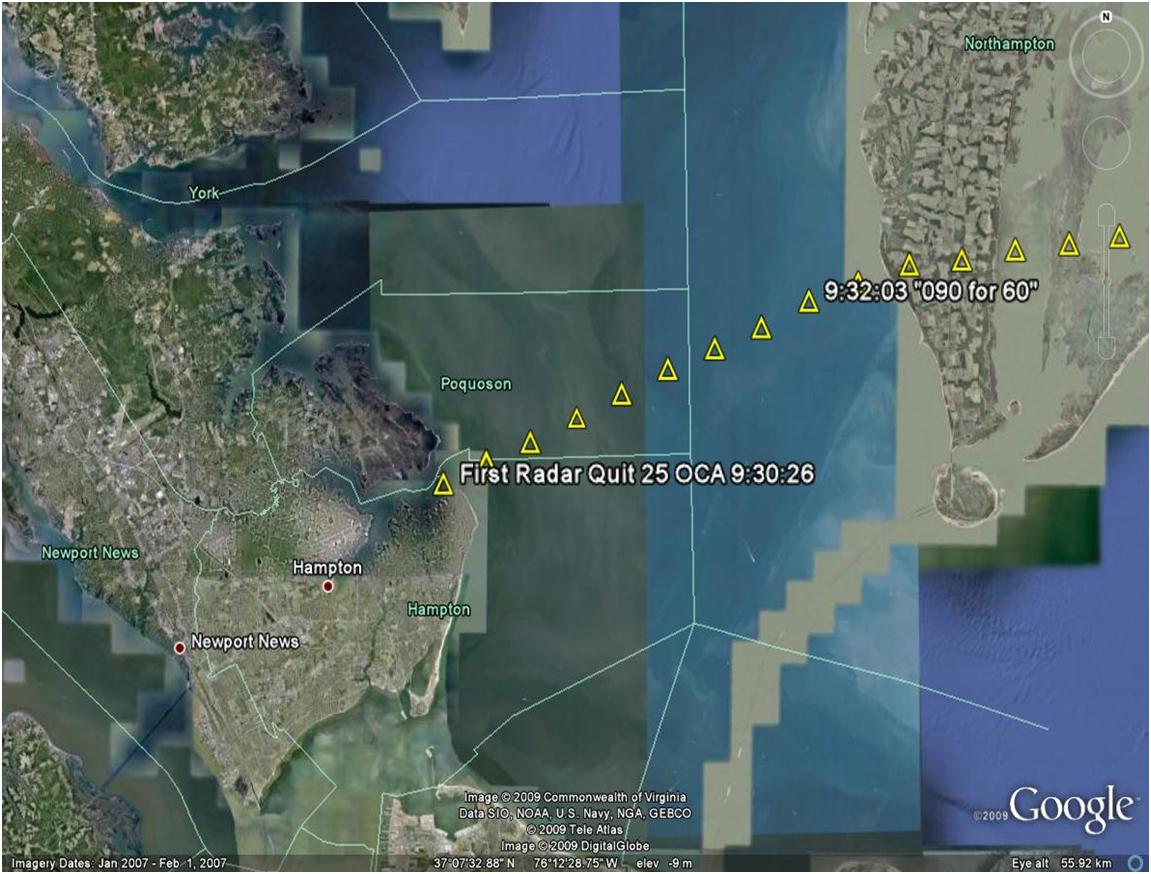
Before continuing further with the Andrews story we need to go back and revisit the Langley fighters for a moment. In the second Langley article I discussed the scramble procedures extant at the time. Those procedures specified that regardless of flight plan the Langley fighters would proceed on runway heading to an altitude of 4000 feet. That segment of the flight is clearly visible on the ground trace of the Langley fighters as determined from 84th RADES radar data.

And it is at that point, just short of the Delmarva Peninsula, that the Norfolk Tower controller and the Quit 25 pilot decided that the flight plan, 090 for 60 prevails over the scramble order and the Quit flight turned slightly right to its flight plan heading. But what does this mean in terms of the NORAD response to events of the day?

Had Quit 25 turned north at that point his flying time to the NCA was still on the order of 12 minutes or so at maximum subsonic, a rate of progress determined over time to be the most effective air defense solution to account for safety, to provide time on target, and to allow an approaching fighter a reasonable chance to spot his target. The Quit flight was not going to have a chance to intercept AA 77 even if the scramble had proceeded as NEADS intended. That meant that NORAD had no chance to effectively engage three of the four hijacked aircraft, AA11, UA 175 and AA 77. That leaves just UA 93 as the only hijacked airplane that either Langley or Andrews would be able to engage. It also mitigates the two askew segments of the Quit flight path to the NCA; they still arrived in time to guard against an approaching UA93; something the Andrews fighters did not do.

The misinformation that AA 11 was still airborne and headed south was the catalyst that got the Langley fighters airborne as soon as they were. It is only because of a proactive error by the Boston air traffic controller, Colin Scoggins, that the nation’s air defenders had any real chance to defend against UA 93; but the expeditionary force fighters at Andrews did not receive that same warning; their warning would come later as we are about to see.

Even though controllers at the scope level at Dulles TRACON had seen a “no tag” soon after 9:25 that observation did not become actionable until Danielle O’Brien saw the fast mover, checked her observation with her fiancé’ sitting at an adjacent screen, and sounded the alarm at 9:33 to National TRACON. Soon thereafter her supervisor notified the Secret Service and quickly the Service and National TRACON established an open line. The Service also picked up the phone and called the late General Wherley at Andrews.

General Wherley’s notes at the time, as reflected in Commission Records (Team 8 Box 8. History Commons is aware of newly released documents), show a time of 0930L (9:30 EDT). The time was actually closer to 9:35. By that time the Secret Service was also following the fast moving unknown, now tagged with an “S,” by National TRACON, visible to the Service. There is a misconception that because the Secret Service had a working relationship with National TRACON that the Service could see any FAA radar feeds from anywhere in the country. That is not true, the only thing the Service could see was what National TRACON was seeing, nothing more.

So, the Andrews alert came at 9:35. It would take them the better part of two hours to get armed fighters in the air with the authority to act. The Langley fighters, scrambled at 9:24 established a CAP over the nation’s capital 36 minutes later, albeit without authority, despite two askew flight segments. How can there be such a difference?

The difference is in the roles and missions of the day, a specific determination by the Department of Defense in order to most effectively use its resources. Just as the three services and the Marines have specific roles and missions, so do their major components and subcomponents. We can leave a more detailed discussion of that for another day, suffice it to say here that the air defense mission and the role of the Langley (and Otis) fighters is distinctly different from the expeditionary force mission and the role of its fighters, such as the Andrews contingent. Only the CONUS air defenders had the tactics, techniques and procedures in place to respond rapidly, and there were just 14 fighters with that mission at seven locations; just two of those locations and four of the fighters were immediately available to NEADS.

Andrews went to work immediately to upload its aircraft and respond, but that took time, time that they did not have. They also recalled the Bully flight, first Bully 2 and then Bully 1 and 3. Even though the Langley fighters had effectively CAPPed the nation’s capital by 10:00 that was not understood or even known within the NCA, including the White House. So when things turned serious with the approach of a now notional UA93, as seen on traffic situation displays at multiple locations, the pressure on Andrews intensified; they had to do something. None of this had anything to do with AA 77 despite accounts to the contrary.

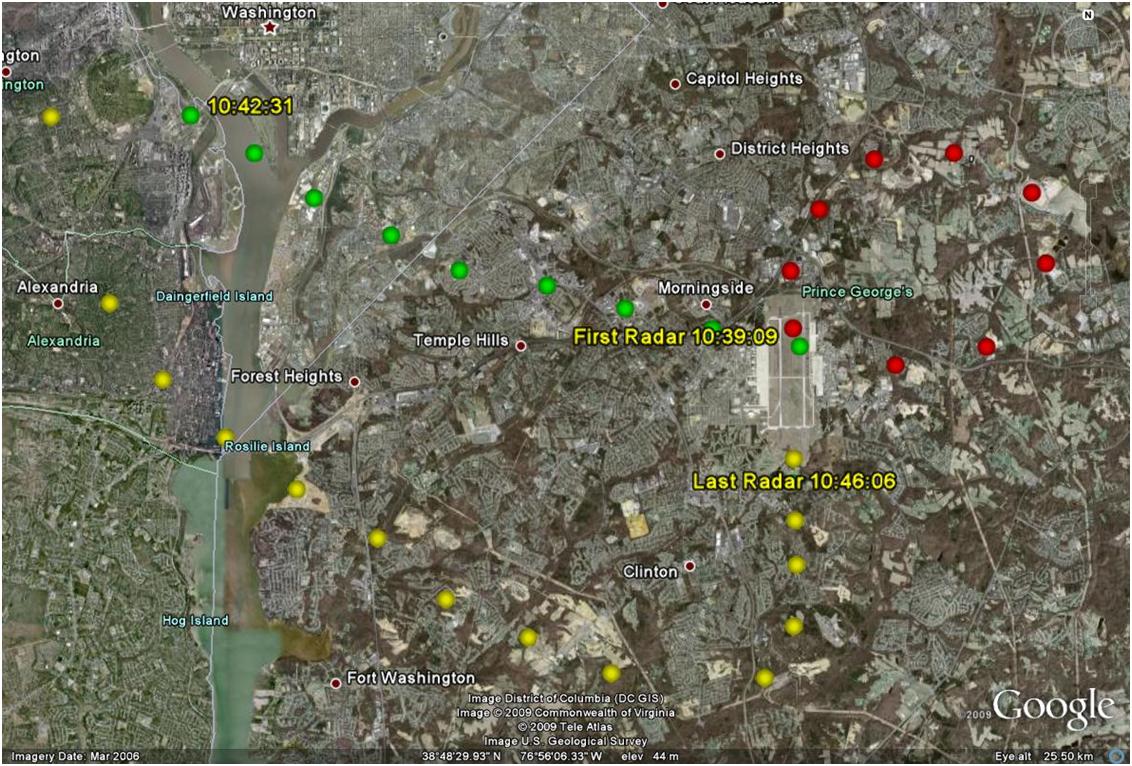
The Andrews flight strips show that Bully 2, who came back alone and well ahead of Bully 1 and 3, landed at 10:14 out of fuel. Bully 1, a flight of two F-16s landed at 10:35, low on gas; however, Bully 1 had sufficient fuel to take off again in response to an unknown coming down the river. By then, the notional UA 93 had “landed” at National at 10:28. There was nothing to intercept. Here is a ground trace of the flight of Bully 1 based on data from 84th RADES.

Major Hutchison was airborne by 10:39 and flew three specific routes. First, he circled to the east back directly over Andrews climbing to an altitude of 3600 feet, shown in red. He then flew directly to the Pentagon, shown in green, and overflew the building at 600 feet shortly after 10:42, exactly as described by Creed and Newman in Firefight to Save the Pentagon. He then turned south, shown in yellow, and climbed back to 3600 feet before landing back at Andrews a short seven minutes after taking off. He was not given “weapons free” authority by General Wherley. The Andrews flight strips show him cleared for takeoff at 10:36 and back on the ground at 10:47, an eleven minute period. Flight strips are not definitive; the radar shows that, at best, Hutchison was in the air for just over seven minutes.

His presence was no longer needed. A pair of Andrews fighters, guns only, and with only verbal (text modified on July 19 based on Commission work files). “weapons free” authority had taken to the air. A handwritten flight strip shows “CAP 1, 2 F-16, airborne at 10:51. (Here I give the benefit of the doubt, the handwriting is not clear and it could be 10:57.)  Finally, at 11:12, Andrews was able to launch the Wild flight of two F-16, fully armed, and General Wherley did give them “weapons free” authority.  The Wild pilots were the other two scheduled for training that day.

Given that all hijacked aircraft had been accounted for, the only issue left by the time the Wild flight got airborne was command and control of the skies over the nation’s capital. That became a bit contentious between the Langley and Andrews fighters. Lynn Spencer in Touching History has a good account of the ‘battle’ for command and control. Spencer, by the way, is the only person who has told an unsung story in the skies that day, the efforts of civilian pilots to help air traffic control. It is a story well told.

Air defense forces and expeditionary forces compared. It took the expeditionary forces, Andrews, 97 minutes (9:35 to 11:12) to retool and reconfigure and get fully armed planes with shootdown authority into the air over the National Capital Region.  It took the air defenders, NEADS/Langley, 51 minutes (9:09 to 10:00; recall that the Langley fighters were placed on battle stations at 9:09) to get fully armed planes over the National Capital Region, but with the authority to only identify by ‘type’ and by ‘tail.’   In sum, given the attack and response as it unfolded that day, neither force could have done anything to prevent the WTC and Pentagon tragedies.  Only the air defense force was in position to do anything about United 93 had its passengers not taken matters into their own hands.

9-11: NORAD’s Sudoku Puzzle; a briefing askew, an addendum

Sunday, July 5th, 2009

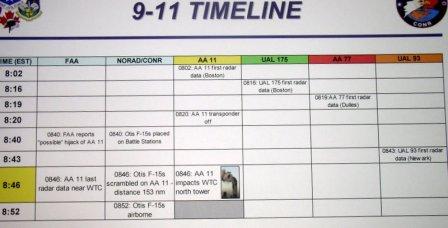
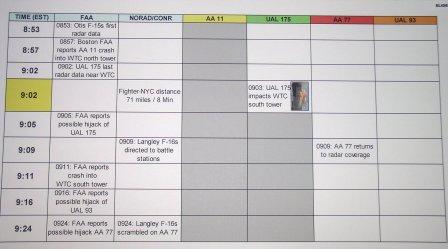
This article provides information as it was briefed to the Commission on May 23, 2003. It complements the article “NORAD’s Sudoku Puzzle; a failure to tell the truth,” which should be read first. In that article you were introduced to Colonel Scott, USAF, retired. It is Colonel Scott who presented the briefing to the Commission. The video of that briefing is available on the Commission’s web site; it does not, however, clearly show the briefing charts used. The charts have recently been made available by NARA and the purpose of this addendum is to share them.

Colonel Scott made it very clear that times on his charts were derived solely from logs, primarily the NEADS MCC/T log; no other source. It is understandable, then, why he would brief a Pentagon impact time of 8:43, for example, as opposed to the actual time. On the other hand, it does not make clear why he would show UA93 impacting near Pittsburgh, as show on his introductory chart.

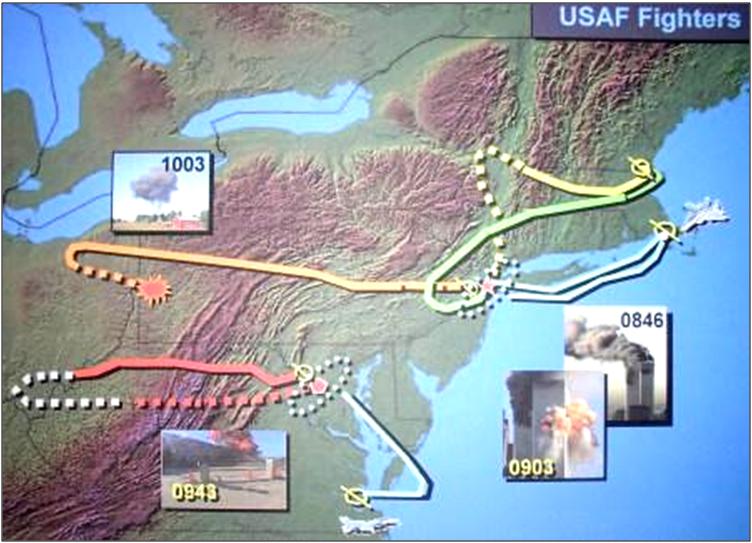
More important, however, is his treatment of the flight path of the Otis fighters and to some extent, the flight path of the Langley fighters as they neared the capital. Scott gave  the impression that the Otis fighters hugged the coast and proceeded directly to New York City, consistent with the account given by the pilots during interviews in 2002. When asked during an interview at CONR why he blurred the scramble path Scott claimed limitations of the Powerpoint program, a disingenuous answer, at best.

The rest of Scott’s charts were timelines, included here for the record. Better renditions will become available when paper copies in Team 8, Box 8 at NARA are uploaded.

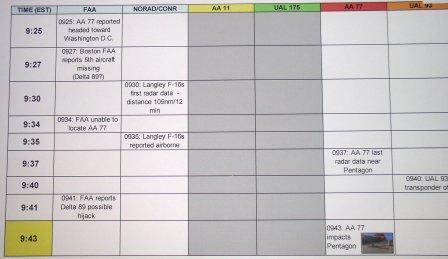
NORAD Hearing First Time Chart

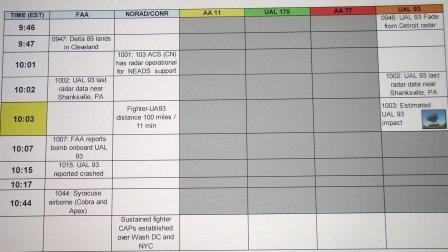
second-time-chart1third-time-chart1fourth-time-chart1

See the May 23, 2003 hearing article for a discussion of the discrepancies. In sum, NORAD read the MCC/T log wrong, twice; first when they prepared their Sep 18, 2001 press release and again when they prepared for the first air defense hearing. In my interviews with both Michael Bronner and Phil Shenon I attributed this to shoddy staff work, primarily at NEADS, which was not adequately vetted at either CONR (Generals Arnold and McKinley) or NORAD (General Eberhart).

The NORAD staff had clear and explicit information available; the radar files, the tapes, and the logs of the day.  On September 25, 2001, in a memo to the US Space Command Directorate of Analysis the 84th RADES included an analysis of radar data for 11 Sep 2001 which included radar text files and Powerpoint slides showing flight paths. On June 3, 2002, a NORAD analyst, Cheri Gott made a presentation to the annual Satellite Toolkit (STK) Conference which was based on 84th RADES data. Moreover, she followed that with a May 13, 2003, briefing to CONR just 10 days prior to the first Commission hearing on air defense. A purpose of Gott’s staff work was to produce a product for the CINC (Gen Eberhart) to use from a Headquarters perspective. Relevant Gott source material is in Team 8, Box 8 at NARA.

NORAD’s failure to provide an accurate accounting of the day is inexcusable for any staff and particularly for a staff that had been at the air defense business for decades.  NORAD failed to accurately read its own logs, tapes and radar files.  Together with FAA it failed to reach agreement on the basic facts of the day in the immediate aftermath when events were fresh.  The NORAD staff failed to adequately prepare its CINC for questions it knew were coming during General Eberhart’s annual testimony to Congress.  Ultimately, NORAD failed to tell the story of the valiant battle by Alpha and Delta flights at NEADS; a story that General Arnold conceded was better than the one they did tell.  Thanks to Michael Bronner that story has been told.